The Weidian Spreadsheet, and what it is for
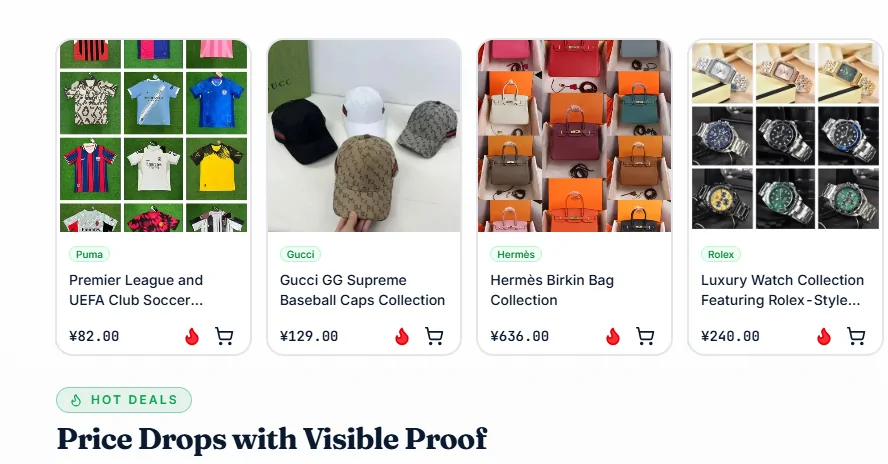
A finds page is a wall of product cards. Each card carries a picture, a name, the marketplace the item sits on, and a link. Nothing more. It exists because browsing Weidian directly means reading Chinese and guessing at search terms, and because the good shops are not always the ones that surface first.
The catalogue we keep held 29,352 item pages when we counted them in its sitemap on 10 October 2026, sorted into categories rather than into one endless feed. This page is about what to do with a card once you have found one.
Reading a card
The four parts of a product card
Only one of them is load bearing. The picture sets your expectation, the name is community shorthand that may or may not match what the seller calls it, and the platform label tells you which buying path applies. The link is the part an agent needs, and the part that goes stale when a seller pulls a listing.
If a link is dead, the item is not necessarily gone. The same product often sits in several shops, so searching the item name on the platform is usually faster than waiting for anyone to fix the card.
The check
Check a listing before you send the link
Use the checklist to identify questions about the seller, available photos, shipping contents and sizing. Resolve each question before paying; a set of selected answers cannot verify a product or predict an order outcome.
Why this Weidian Spreadsheet is worth trusting, and where it is not
Plenty of link collections exist. Most are a chat channel with a few hundred messages in it, and they rot: sellers pull listings, prices move, and nobody goes back to check. Here is exactly what our catalogue does for you and what it does not.
What the catalogue does
- Sorts listings into categories so you can browse without reading Chinese
- Keeps one link per item rather than a thread of replies
- Names the marketplace each item sits on, so you know which buying path applies
- Held 29,352 item pages when we counted its sitemap on 10 October 2026
What it does not do
- Verify that any item is authentic, and no catalogue anywhere can
- Guarantee a link still resolves, because only the seller controls that
- Rank sellers, because shop records change faster than any list
- Set prices or freight, which are the seller and the agent decisions
Why the shop record carries the most weight
On a marketplace of independent shops, the shop is the product. A seller that has moved hundreds of the same item has already had every complaint you are about to have, and has either fixed it or been buried by it. A shop with one listing and no history has not been tested by anyone.
What to look at: how long the shop has been trading, how many of this exact item it has sold, and whether the pictures in the listing are the same generic set you have already seen in ten other shops.
And why the cheapest listing is usually a different item
When the same product appears at eight prices, the bottom one is rarely a bargain. It is usually a different version: thinner material, a simpler sole, a different movement, a smaller print. Nothing about it is dishonest. It is just not the thing in the photo.
The useful move is to ignore both extremes, look at what the middle of the range costs, and then decide whether that number is worth the freight.
Next steps
How to use your checklist results
Read each follow-up question separately. Resolve the seller, photo, shipping and sizing uncertainties before payment; this checklist produces no quality score or purchasing verdict.
The QC photos are the real check
Everything above happens before anyone has seen the item. The first independent look comes after the seller ships to the agent warehouse, when the warehouse photographs what actually arrived. LoongBuy states that its team inspects each item and takes photos before storing it.
That is the moment to be picky, because it is the last one before the box gets expensive to move. What to look for by category is on the ordering page.
Go and browse something
Four places to start. Each link opens that category of real listings.